
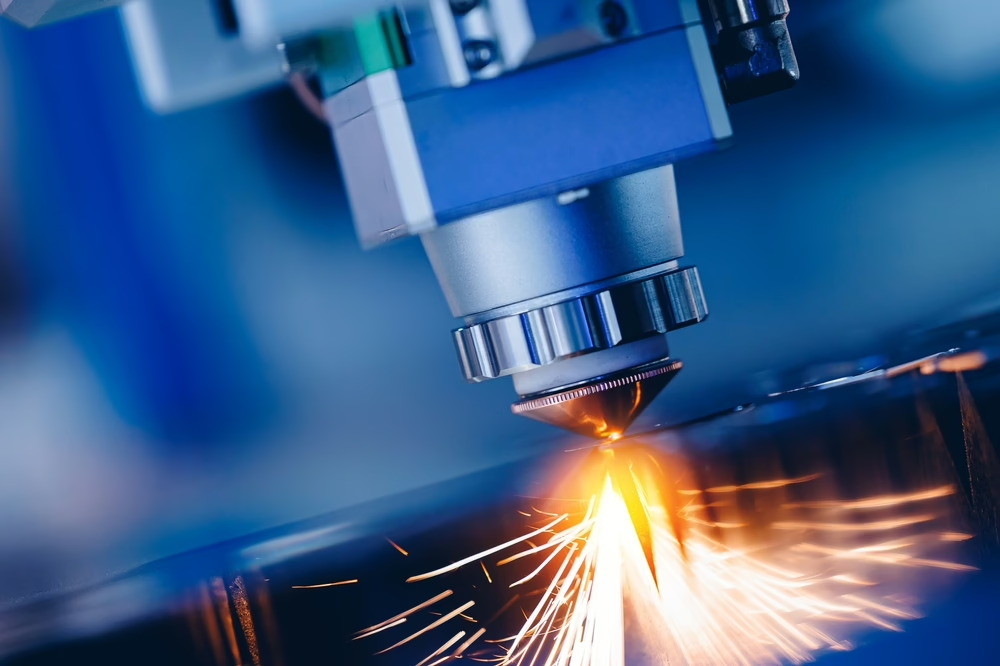
At Cer-Mac Inc., we treat temperature as a major engineering variable rather than a passive environmental byproduct. In a facility specializing in tight-tolerance components, precision is governed by the laws of thermodynamics: a part measured at 7:00 AM in a non-temperature controlled environment might be perfect, but by mid-morning, that same component could measure ten microns oversize.
This phenomenon is a product of thermal expansion, the predictable but often disruptive growth of material as it absorbs kinetic and ambient energy.
Why Temperature Accuracy Isn’t Negotiable
Put simply, heat makes things bigger. That’s physics at its most basic level, but the implications for precision machining are anything but simple. When you’re working with tolerances measured in tenths of thousandths of an inch, thermal expansion becomes one of the most significant factors influencing whether parts meet specification or end up in the scrap bin.
Every material expands at a different rate when heated. Steel behaves differently from aluminum. Titanium responds to temperature changes in ways that brass never will. Even the machine tools themselves expand and contract throughout the day as they warm up and as ambient conditions fluctuate. Understanding these thermal effects isn’t optional for maintaining dimensional accuracy. It’s fundamental to producing consistent precision machined parts.
The Science Behind Thermal Expansion in Machining
Materials expand predictably based on their coefficient of thermal expansion (CTE). This value tells you how much a material will grow per unit length for each degree of temperature change. The challenge in precision machining is that multiple materials with different CTEs interact simultaneously.
Consider a typical turning operation. You have the workpiece material, the cutting tool material, the machine spindle material, and the coolant temperature all influencing the process. As cutting generates heat, the workpiece expands. The tool expands. The spindle bearings warm up and change their clearances. Meanwhile, you’re trying to hold tolerances that allow less movement than what thermal expansion naturally creates.
Here’s how different materials respond to temperature changes:
| Material | Coefficient of Thermal Expansion (per °F) | Impact on Machining |
| Aluminum | 13.1 x 10⁻⁶ | Expands rapidly; significant dimensional changes with heat |
| Stainless Steel | 9.6 x 10⁻⁶ | Moderate expansion; heat from machining affects tolerances |
| Titanium | 4.9 x 10⁻⁶ | Lower expansion; more stable but still affected by heat |
| Inconel | 7.2 x 10⁻⁶ | Moderate expansion; generates significant machining heat |
| Brass | 10.4 x 10⁻⁶ | Higher expansion; requires thermal management |
These numbers might look small, but they translate to real dimensional changes. A 10-inch aluminum part that heats up by just 20 degrees Fahrenheit will expand by more than two thousandths of an inch. That’s huge when you’re working with tolerances of plus or minus five tenths.
How Heat Enters the Machining Process
Understanding where thermal expansion comes from helps you control it. Heat comes from specific, identifiable sources that affect dimensional accuracy in predictable ways.
Primary Heat Sources in Machining:
- Cutting action friction between tool and workpiece
- Chip formation and deformation of material
- Tool wear generating additional friction and heat
- Spindle bearing friction during operation
- Ambient temperature variations throughout the day
- Coolant temperature fluctuations
Each of these sources contributes to the total thermal load affecting your parts. Cutting speeds and feeds directly influence how much heat gets generated. Dull tools create more friction and heat than sharp ones. Even something as small as the time of day matters as most shops experience temperature swings due to changes in their heating or cooling systems cycles. Real-World Effects on Machining Operations
The theoretical understanding of thermal expansion means nothing if you can’t see how it actually affects your work. Let’s look at what happens in common machining scenarios.
CNC Turning Operations
During the turning process, the workpiece rotates at high speed while the cutting tool removes material. This continuous friction generates significant heat that flows into both the part and the tool. As the part heats up, its diameter increases. If you’re turning a 2-inch diameter steel shaft to a tolerance of plus or minus 0.0005 inches, a temperature rise of just 10 degrees can push you out of specification.
The problem compounds with long, slender parts. A thin-walled tube will not only expand but may also distort as heat distributes unevenly. The section being cut heats up faster than the rest of the part, creating temporary dimensional changes that disappear once everything cools to room temperature. You might machine a part that measures perfectly while still warm, only to discover it’s undersized once it cools.
CNC Milling Operations
Milling presents different thermal challenges because the workpiece remains stationary while the cutter rotates. Heat generation happens at the cutting edge, but that heat has multiple paths to travel. Some heat goes into the chips being cut away. Some flows into the workpiece. Some heat the cutter itself.
Multi-axis machining operations like those performed on advanced CNC milling centers create complex thermal situations. When you’re holding tolerances of a few tenths across large plate work, the temperature gradient from one side of the part to the other can cause measurable warping. The portions of the part being actively machined expand while cooler sections maintain their original dimensions, creating internal stresses that only relax after machining completes.
Wire EDM and RAM EDM
Electric discharge machining operates through a completely different mechanism than conventional cutting, but thermal expansion still matters. EDM generates intense localized heat as electrical sparks erode material. Although the process uses dielectric fluid for cooling, parts still experience temperature changes.
Wire EDM’s advantage is that it applies minimal force to the workpiece, but the thermal energy from the spark discharge still causes expansion. When you’re cutting intricate profiles or tight-tolerance punch tooling, the difference between a part at 68 degrees and one at 85 degrees matters. RAM EDM faces similar challenges when burning cavities or complex shapes where different sections of the part may be at different temperatures.
Strategies for Managing Thermal Effects
You can’t eliminate thermal expansion, but you can manage it through careful process control and strategic planning. Professional CNC machine shops employ multiple techniques to minimize thermal effects on dimensional accuracy.
Temperature-Controlled Environments
The most effective solution is also the most expensive: maintain consistent ambient temperature throughout your facility. Climate-controlled machining and inspection areas keep everything at a stable temperature, reducing thermal gradients and creating predictable conditions. When the shop, the machines, the tooling, and the workpieces all stay at the same temperature, thermal expansion becomes manageable.
This doesn’t require laboratory conditions. Keeping your machining area within a 5-degree window throughout the day eliminates most ambient thermal problems. Many high-precision shops target 68 degrees Fahrenheit as their standard because it matches the reference temperature used for inspection and measurement.
Machine Warm-Up Procedures
Professional machinists know that machines need time to reach thermal equilibrium before producing precision parts. The first parts run in the morning rarely match the dimensional accuracy of parts produced after machines have been running for an hour or two.
Warm-up cycles involve running machines at operating speeds without cutting to allow spindles, bearings, and structural components to reach stable temperatures. Some shops run standard warm-up programs every morning.
Coolant Management
Cutting fluid does more than lubricate and clear chips. It’s a primary tool for managing workpiece temperature and controlling thermal expansion. Consistent coolant temperature and proper application help maintain dimensional stability during machining.
Key Coolant Considerations:
- Maintain constant coolant temperature within 2-3 degrees
- Use adequate flow rates to remove heat effectively
- Apply coolant strategically to control workpiece temperature
- Monitor coolant condition as degraded fluid loses thermal properties
- Consider through-spindle coolant delivery for deep hole operations
Strategic Process Planning
Sometimes the best way to manage thermal expansion is to work with it rather than against it. This means planning your machining sequence to account for temperature effects.
For parts requiring multiple operations, you might perform roughing cuts first, allow the part to cool and relax, stabilize the parts by stress relieving them with a heat treatment operation, then perform finish operations when the part returns to a stable temperature. When machining materials with high thermal expansion coefficients like aluminum, you might intentionally machine parts slightly undersize knowing they’ll grow as they warm up to room temperature.
Material-Specific Considerations
Different materials demand different approaches to thermal management. Understanding how your specific workpiece material responds to heat helps you develop appropriate machining strategies.
Aluminum’s high coefficient of thermal expansion makes it particularly sensitive to temperature changes. When machining aluminum components to tight tolerances, aggressive coolant use and allowing parts to cool between operations becomes essential. Swiss turning operations with aluminum bar stock require careful attention to thermal effects because the material expands significantly even with modest temperature increases.
Titanium generates substantial heat during machining despite its relatively low thermal expansion coefficient. The material’s poor thermal conductivity means heat concentrates in the cutting zone rather than dissipating throughout the part. This creates localized hot spots that expand independently from the rest of the component. Stress relieving Titanium allows for parts to have a more uniform coefficient, reducing the amount of potential localized hot spots.
High-nickel alloys like Inconel and Hastelloy present challenges on both fronts. They generate tremendous cutting heat while also experiencing moderate thermal expansion. Machining these materials to precision tolerances requires careful tool selection, optimal cutting parameters, and aggressive thermal management.
Cer-Mac Inc: Where Precision is the Standard
At Cer-Mac Inc., we understand that thermal expansion isn’t just a theoretical concern, it’s a daily challenge in producing precision components that meet exact specifications. Our ISO 9001:2015 certified processes include temperature management strategies developed over more than 50 years of precision machining experience.
From CNC swiss turning and milling to Wire EDM and specialized grinding operations, we control the factors that affect dimensional accuracy throughout every operation. Whether you’re working with aluminum, stainless steel, titanium, or exotic alloys like Inconel and Hastelloy, our team knows how thermal effects influence each material and how to compensate for them. Contact Cer-Mac Inc. today to discuss how our precision machining capabilities can deliver the dimensional accuracy your critical components demand.