Manufacturing changed forever the moment computers took complete control over traditional industrial cutting tools. Have you ever looked at a complex aerospace bracket and wondered how CNC milling machines work to create such precise shapes? These heavy-duty machines represent the vital backbone of modern American production facilities from coast to coast. They transform raw blocks of metal or plastic into highly accurate finished parts through a controlled subtractive manufacturing process.
We will explore the mechanics, software, and physical components that make this precision machining technology so highly effective. Operators and facilities like Cer-Mac Inc. rely on these advanced systems daily to meet strict production quotas and maintain tight delivery schedules.
The Digital Intelligence of Modern Milling: Programming and Control
Before looking at the physical cutting process, you must understand the digital brain operating behind the scenes. Computer Numerical Control replaces manual handwheels and mechanical levers with extremely precise digital instructions and automated movements. During standard CNC mill operation, an operator inputs a program, and the machine reads these G-code commands to move cutting tools along specific paths. This automation significantly reduces the potential for human error and allows for rapid, highly repeatable production runs across multiple shifts.
The process fundamentally relies on the Cartesian coordinate system to map out the entire physical workspace. Every movement maps to specific X, Y, and Z axes within the enclosed machining area. Motors receive electrical signals from the controller and drive the tool to these exact mathematical coordinates. This precise digital mapping allows shops to produce parts with tolerances much tighter than a human hair. The controller constantly adjusts motor torque to maintain smooth motion during heavy material removal operations, a standard of quality championed by the team at Cer-Mac Inc.
Essential CNC Mill Components: Understanding CNC Machining Hardware
A CNC mill contains several heavy-duty and critically important parts working together in perfect mechanical synchronization. The foundation is the machine bed, a vital CNC mill component that provides a massive, stable base to absorb vibrations. On top of this bed sits the worktable, where operators secure the raw material using heavy vises or specialized workholding fixtures. Stability at this foundational level directly dictates the final dimensional accuracy of the manufactured part.
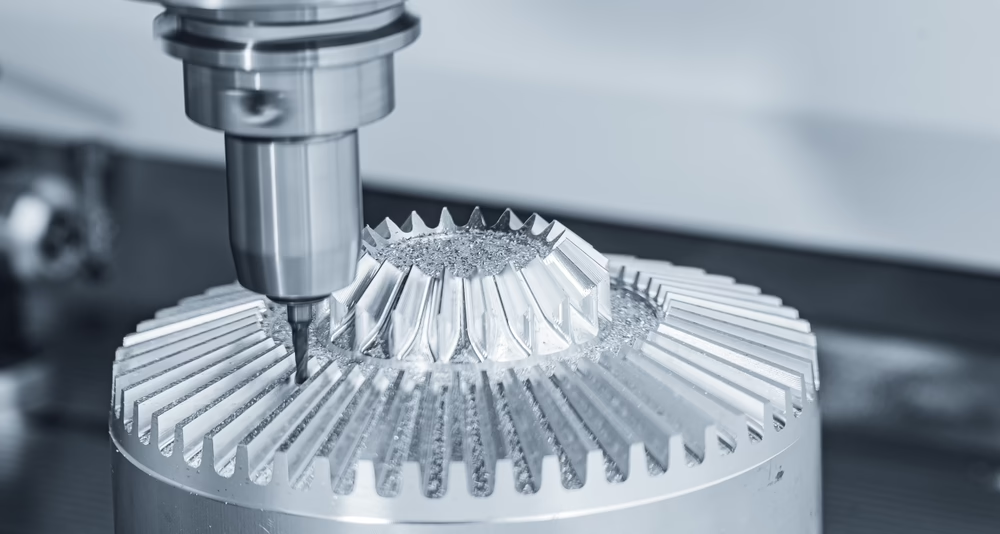
Above the worktable, you will find the spindle assembly and the various sharp cutting tools. The spindle holds the tool securely and rotates it at spindle speeds often exceeding 10,000 revolutions per minute. Various cutting tools, like solid carbide end mills and face mills, attach to the spindle for specific cuts. An automatic tool changer frequently swaps these tools out in seconds without any direct human intervention. This automation allows the machine to perform multiple different cutting operations during a single setup.
Finally, the control panel serves as the primary digital interface between the operator and the machine hardware. This station displays the current active program, absolute machine coordinates, and critical performance metrics during the cycle. Operators use this panel to load programs, adjust feed rates, and monitor the overall health of the equipment. Expert technicians at Cer-Mac Inc. utilize these interfaces to make sure every run meets exact client specifications.
CNC Milling Workflow: How to Process a Part from Concept to Completion
Moving a product from a simple idea to a physical object requires a specific sequence of technical steps. Engineers and machinists follow a standardized workflow to guarantee the final part matches the original design specifications. This logical workflow bridges the gap between digital modeling software and heavy industrial cutting hardware.
The Standard CNC Machining Process: A Step-by-Step CNC Milling Workflow
- Design the CAD Model: Engineers create a highly detailed 3D representation of the part using Computer-Aided Design software.
- Generate the CAM Program: Programmers use Computer-Aided Manufacturing software to translate the 3D model into specific toolpaths and G-code.
- Set Up the Machine: The operator loads the raw material into the vise, installs cutting tools, and sets the zero coordinate points.
- Execute the Machining Cycle: The machine runs the generated code to cut the material while the operator continuously monitors the process.
Completing these foundational steps correctly prevents costly machine crashes and wasted material during the production run. Machinists spend years mastering this exact workflow to optimize cutting speeds and extend the life of their tools. Proper execution routinely saves American machine shops thousands of dollars in ruined raw materials every single month.
CNC Programming: Understanding G-Code, M-Code, and Toolpaths
The language that actually drives these powerful machines consists of alphanumeric commands known as G-code and M-code. G-codes primarily dictate geometry, telling the machine exactly where to move, how fast to travel, and what toolpaths to follow. For example, a basic G01 command instructs the cutting tool to move in a straight line at a specific feed rate.
M-codes handle the miscellaneous machine functions that do not involve actual physical movement along the primary axes. These commands turn the spindle on and off, activate the coolant flow, or trigger the automatic tool changer mechanism. Together, these two code types provide a complete set of digital instructions for the entire manufacturing cycle. Precision shops like Cer-Mac Inc. pride themselves on clean, efficient code that maximizes machine uptime.
3-Axis vs 5-Axis: The Significance of Multiple Machining Axes in Precision Machining
Understanding how CNC milling machines operate requires considering how many axes they can control. Why do some modern facilities spend millions of dollars on machines with extra axes of movement? Traditional mills operate on three linear axes, moving left-to-right, front-to-back, and up-and-down during the cutting cycle.
More advanced manufacturing facilities utilize sophisticated four-axis and five-axis milling centers for highly complex geometries. A five-axis machine adds two rotational axes, allowing the cutting tool to approach the workpiece from almost any angle. This impressive capability lets manufacturers produce intricate aerospace impellers or medical implants without moving the part between different machines. Upgrading to a five-axis system requires significant capital investment and highly skilled programmers to run the equipment safely. However, the dramatic reduction in setup times and improved part accuracy often justify the initial expense for specialized machine shops.
Industrial Materials: Common Materials Used in the CNC Machining Process
These robust machines possess the rigidity and horsepower to cut through a massive variety of hard industrial materials. Aluminum remains a popular choice due to its excellent machinability, light weight, and relatively low material cost. Many modern machine shops keep large stockpiles of 6061 aluminum for general-purpose prototyping and high-volume production runs.
For demanding applications requiring high strength and extreme heat resistance, machinists turn to harder metals like stainless steel, high nickel alloys, and titanium. Cutting these tough alloys requires specialized carbide tools, slower feed rates, and high-pressure coolant lines to prevent catastrophic overheating. Cer-Mac specializes in machining high nickel alloys such as Inconel 718. The material is very tough to machine, Inconcel 718 is used in the oil industry because of its high-temperature strength, corrosion resistance and structural stability in high pressurized environments.
The medical and aerospace sectors rely heavily on titanium for its impressive strength-to-weight ratio and excellent human biocompatibility. Modern mills also frequently process various industrial plastics, including Delrin, polycarbonate, and high-performance PEEK polymers. Plastics require very sharp tools and specific cutting strategies to prevent the material from melting or chipping during rapid machining.
Precision Machining Applications: Industrial Impact of CNC Milling
The United States manufacturing sector depends heavily on CNC milling technology to maintain its global economic competitiveness. The aerospace industry uses these machines to carve lightweight structural components out of aluminum and titanium billets.. These high-precision structural parts keep commercial aircraft safe while minimizing overall weight to greatly improve fleet fuel efficiency.
The medical device industry relies heavily on specialized milling to produce joint replacements, surgical instruments, and titanium bone screws. These critical items require strict adherence to tight tolerances and exceptional surface finishes to function safely inside the human body. CNC technology provides the consistency required to meet stringent FDA manufacturing regulations day after day. Cer-Mac Inc. understands that in these industries, precision is not just a goal, but a requirement for safety and performance.
Automotive manufacturers utilize massive milling centers to produce aluminum engine blocks, heavy transmission cases, and custom prototyping parts. The ability to rapidly iterate designs and immediately produce test components accelerates the entire modern vehicle development cycle. This technology allows car companies to bring safer, much more efficient vehicles to the consumer market faster than ever before.
Conclusion
Understanding how CNC milling machines work reveals how incredible precision drives modern manufacturing forward every day. These highly automated systems combine robust physical hardware with sophisticated digital programming to shape the physical world around us. From the smartphone in your pocket to the commercial airplanes flying overhead, milled components make modern life possible.
The capabilities of CNC manufacturing will only continue to expand as software improves and machine designs become more rigid. Operators and mechanical engineers constantly push the practical boundaries of what these heavy-duty machines can actually create.
Mastering this technology remains absolutely essential for any company looking to produce high-quality products in today’s competitive market. By bridging the gap between digital design and physical reality, CNC milling continues to define the future of global industry. Contact Cer-Mac today to learn more.