
Have you ever streamed a live concert or event on your phone from the other side of the world? Losing yourself in a flawless audio-visual experience isn’t possible without the utmost skill and craftsmanship.
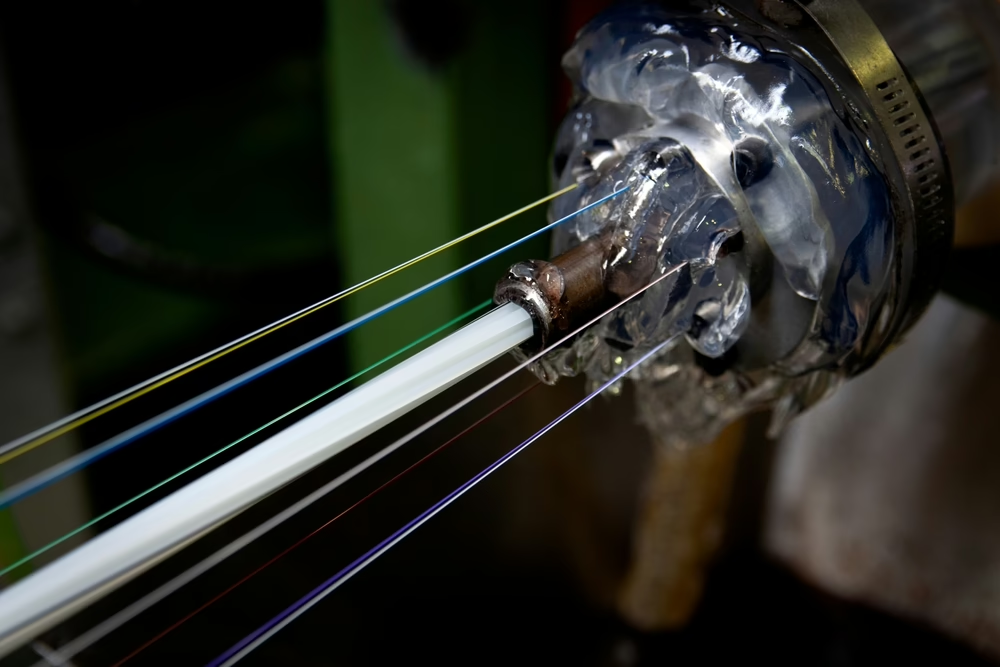
We often overlook the hidden world beneath us: thousands of miles of glass fibers thinner than a human hair carrying pulses of light at incredible speeds. The signals flow through meticulously crafted connectors and housings, so finely aligned that a tiny error could bring the whole system to a halt.
This microscopic universe is where precision machining shines. The tiny but vital components, like ferrules and connectors, must work perfectly to keep data flowing smoothly. Your uninterrupted streaming is the result of skillful craftsmanship, high-performance materials, and exacting standards maintained at the micron level.
Cer-Mac Inc stands at the forefront of this specialized craft, leveraging decades of experience and state-of-the-art equipment to deliver the components that make global communication possible.
Why Precision Is Mission-Critical for Fiber Optics
Fiber optic systems are incredibly sensitive. Light signals travel through glass fibers with minimal loss, but even the smallest misalignment or surface imperfection can cause significant problems. Imagine a single speck of dust or a tiny dent altering how light pulses move; that microscopic disruption could result in signal attenuation, reflection, or complete data loss.
Deviations as tiny as 10 microns, which is less than half a thousandth of an inch, can degrade signal integrity. Because fiber optic connectors and housings are made from multiple parts, every small error stacks up, amplifying the risk of failure. These components must withstand demanding environments, from harsh outdoor conditions on telecom towers to high data throughput inside data centers, all while maintaining ultra-low latency.
A deep understanding of these stakes drives the precision standards that manufacturers adhere to, ensuring every ferrule, connector, and housing part meets strict micron-level tolerances. Rigorous quality control measures minimize tolerance stacking, making sure that every component works perfectly within the whole assembly. This meticulous approach is essential for keeping telecommunications networks reliable under all conditions.
The Precision Machining Toolbox That Powers Connectivity
Producing flawless fiber optic components requires a comprehensive toolkit and specialized skills. Advanced machining processes tailored for fiber optic applications include:
- 5-Axis CNC Machining: Large-format, high-precision 5-axis machining helps craft housing bodies and complex multi-angle parts. These machines can navigate intricate geometries while maintaining micron-level tolerances critical for optical alignment.
- Swiss CNC Turning: Ferrules, sleeves, and tips are produced using Swiss CNC lathes optimized for tiny, precision parts. This method guarantees perfect symmetry and smooth finishes, which are vital to avoid signal disruption.
- Wire EDM (Electrical Discharge Machining): Thin ribs, slots, and notches are machined without mechanical stress or deformation, thanks to fully automated EDM cells that deliver micro-cut accuracy.These wire EDM capabilities allow the process to stay in motion.
- Precision Grinding and Lapping: Grinding and lapping equipment achieves optical-quality surfaces with flatness less than 0.0005 inches, ensuring mirror-smooth contact points necessary for signal clarity.
- Coordinate Measurement Machines (CMM): Every component undergoes rigorous dimensional inspection using in-line metrology systems equipped with Statistical Process Control (SPC). This ensures parts meet or exceed design specifications before shipping.
Investment in this suite of machinery, combined with process automation and expertise, allows manufacturers to consistently produce parts that enable seamless fiber optic connectivity.
From Design Conversation to Final Evolution
Producing fiber optic components is a collaborative effort involving close communication between designers and manufacturers. This process typically includes:
- Blueprint Review and Material Selection: Engineers analyze design blueprints, offering insights on material choices, ranging from stainless steel and aluminum to high-performance plastics, based on strength, thermal properties, and machinability.
- Prototype Run: Small batches are produced to validate fit, finish, and optical alignment. Rapid prototyping allows clients to test and refine designs early in the process.
- Feedback and Iteration: Using precise measurement data, machining parameters, tooling paths, and part features are refined to optimize performance and manufacturability.
- Scale-Up to Production: Once prototypes are approved, production transitions to optimized runs with automated CNC programming and quality checks that ensure repeatability at scale.
- Metrology-Driven Quality: Throughout larger scale production, every split delivery undergoes stringent inspections, including first-article CMM scans and ongoing SPC monitoring to maintain consistent, traceable quality.
This structured process transforms fiber optic components from concept to finished product, providing customers with confidence that their parts will perform flawlessly in the field.
Core Advantages of Precision Machining
Key strengths of top precision machining providers include the ability to operate at micro-tolerance levels, which is critical for parts like ferrules and housings where the margin for error is minuscule. This precision ensures the alignment of optical fibers is maintained, preserving signal integrity. Precise repeatability is essential in the machining process.
Material expertise is broad, spanning titanium, stainless steel, aluminum, ceramic, and high-performance polymers. Each material is chosen and machined to maximize durability, thermal stability, and signal clarity based on specific application requirements.
Streamlined workflows seamlessly bridge prototyping and production. Rapid prototyping capabilities accelerate time to market without sacrificing accuracy. Advanced in-house metrology systems provide continuous quality feedback, guaranteeing every component shipped meets tight specifications.
Experienced operators and engineers with deep machining knowledge oversee each project, offering design consultation and maintaining open communication. Quality systems backed by ISO and ITAR certifications reinforce the robustness of manufacturing processes, giving customers peace of mind that each part meets the highest industry standards.
Facing the Future: Telecom Needs Manufacturers Are Ready For
As the telecommunications landscape evolves, so do the demands on fiber optic components. The global rollout of 5G networks requires micro-connectors that are smaller, lighter, and stronger than ever before. Precision machining capabilities enable the production of these next-generation parts, which are crucial for edge computing and ultra-fast data transmission.
Adaptive manufacturing uses real-time CNC feedback and Statistical Process Control to ensure consistent quality, even as designs or volumes rapidly change. Exploration of new materials such as thermally stable alloys and rugged composites keeps pace with future network performance requirements.
Operational agility is essential, with the ability to handle urgent orders, quick design iterations, and complex change requests while maintaining excellence. This responsiveness supports success in a fast-paced industry driven by innovation and tight deadlines.
Why Engineers Trust Precision Machining Experts
Component reliability is paramount in the telecommunications industry. Engineers consistently choose manufacturers who deliver micro-machining excellence, producing near invisible but vital features that ensure clean, high-speed signals.
An integrated ecosystem of advanced machining tools and rigorous quality systems creates a seamless workflow from initial design to finished product. Agile prototyping fosters collaboration, enabling clients to provide feedback early and often, preventing costly redesigns later.
Scalability is also critical. Whether projects require hundreds or thousands of units, manufacturers maintain precision and consistency at every scale. While technical expertise is critical, meaningful client interactions build trust and support the long-term success of a project.
Precision Machining Techniques and Their Value
| Machining Process | Typical Components | Value to Fiber Optics | Key Strengths |
| 5-Axis CNC Machining | Housing bodies, complex parts | Handles intricate geometries with micron-level accuracy | Large-format, high-precision 5-axis systems |
| Swiss CNC Turning | Ferrules, sleeves, tips | Maintains symmetry and surface finish for optimal light transmission | Swiss lathes optimized for micro-scale parts |
| Wire EDM | Thin ribs, notches, slots | Stress-free machining of delicate features | Fully automated EDM cells with micro-cut accuracy |
| Precision Grinding & Lapping | Contact ends, internal surfaces | Achieves mirror-smooth finishes under 0.0005″ flatness | Fine grinding and lapping for optical-grade surfaces |
| Coordinate Measurement (CMM) | Final part inspection | Ensures exact dimensional and surface specs | In-line metrology with SPC and first-article reporting |
Discover How Microns Shape Performance
Machined fiber optic components make connecting, streaming, and communicating possible. Precision may be invisible to users, but it is the backbone of modern telecommunications.
When networks demand zero errors and high bandwidth, carefully crafted connectors and housings built with unwavering accuracy keep data flowing. The machinists behind these critical components transform digital communication from possibility to reality.
If you are building next-generation fiber optic networks, remember that true performance lies in the details measured in microns.
Designing fiber optic connectors that demand uncompromising precision? Seeking manufacturing partners who obsess over every micron so you don’t have to?
Reach out to Cer-Mac Inc’s machining experts to start a conversation, request a quote, and discover how precision machining can bring your high-speed connectivity projects to life.