
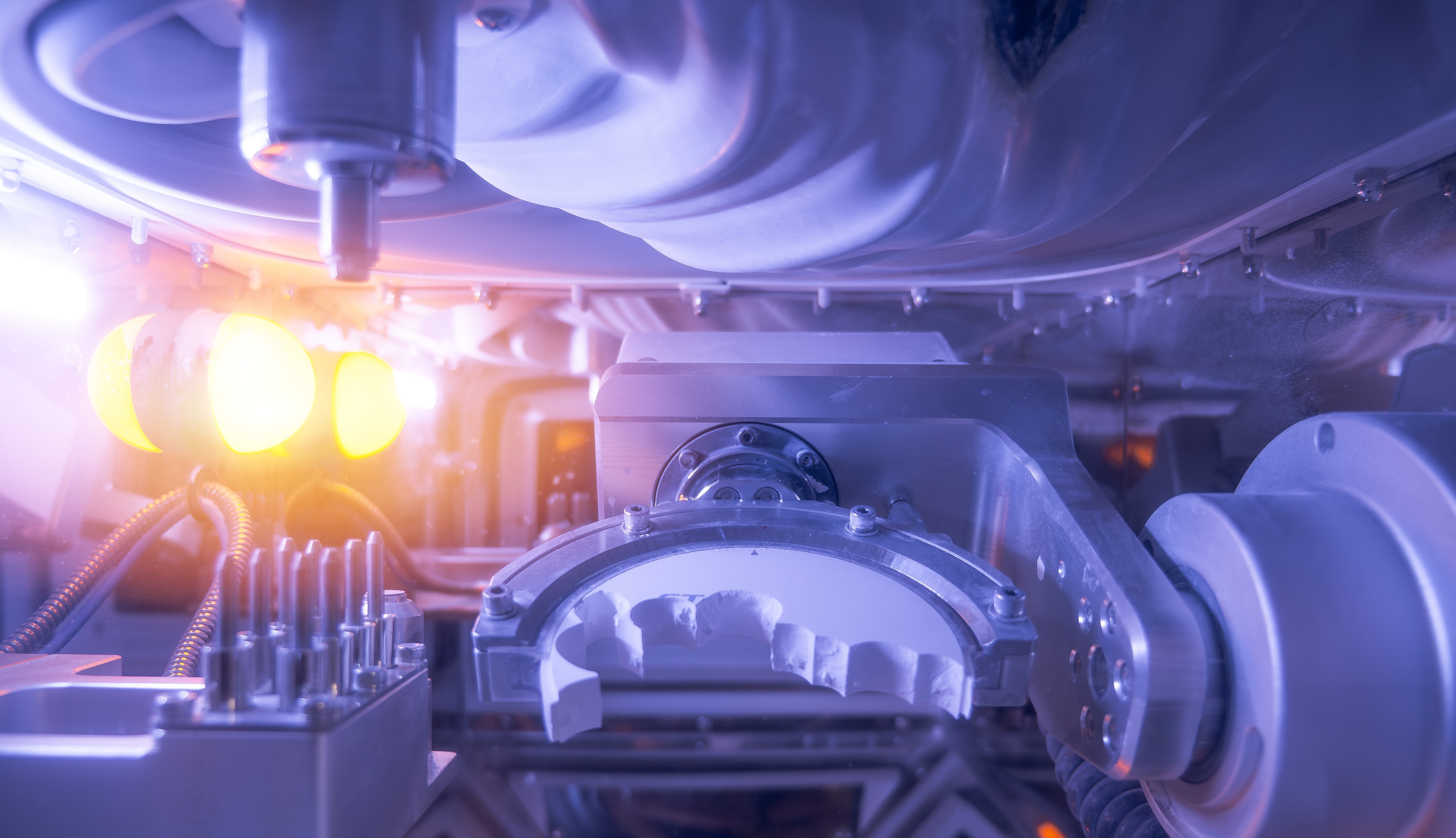
Titanium Grade 5 (Ti-6Al-4V) is widely used in both aerospace and medical applications because it is strong, lightweight, and resistant to corrosion. However, titanium does not conduct heat very well, so much of the heat created during machining stays near the cutting tool instead of being carried away with the chips. This makes tool wear and controlling the cutting process especially important. The machining knowledge needed to work with Titanium Grade 5 is one reason aerospace machining specialists often find a natural fit within the medical industry. The basic machining challenges are similar, although medical parts require an even greater focus on cleanliness and process control.
Why Ti-6Al-4V Destroys Cutting Edges So Quickly
Titanium’s low thermal conductivity prevents heat from dissipating, concentrating extreme temperatures (above 900°C) into a tiny contact zone smaller than a grain of rice. At these high temperatures, titanium chemically reacts with and sticks to the tool material. This causes rapid diffusion wear, chipping, and material buildup (built-up edge) long before standard abrasive wear sets in, making heat management and cutting-edge protection the central challenges of machining titanium. The alloy’s low elastic modulus compounds the problem, since thin implant walls deflect away from the tool and then spring back, rubbing the flank face.
Practical consequences show up fast on the shop floor:
- Short tool life: 15 to 30 minutes of cutting time per carbide edge is common in roughing, versus several hours in 4140 steel.
- Notch wear at the depth-of-cut line, caused by work hardening from the previous pass, is the most frequent cause of sudden edge failure.
- Chip welding, where titanium galls onto the rake face and then tears away a fragment of carbide with it.
- Fire risk from fine titanium chips and dust, which demands wet machining and disciplined housekeeping.
Cutting Parameters That Actually Extend Edge Life
The instinct to slow down is only half right. Surface speed needs to stay conservative, typically 30 to 60 m/min (roughly 100 to 200 SFM) with uncoated or AlTiN-coated submicron carbide, but feed per tooth should stay healthy at 0.05 to 0.15 mm so the edge cuts under the work-hardened layer rather than burnishing it.
Coolant strategy matters more than grade selection in most cases. High-pressure through-tool coolant at 70 bar (1,000 psi) or above breaks chips, lifts them clear of the pocket and pulls heat out of the contact zone, often doubling tool life compared with flood coolant alone. Trochoidal toolpaths with radial engagement held near 10 percent of diameter spread wear along the flute instead of burning one spot.
For finishing operations on acetabular cups, bone screws and spinal cages, most shops run a dedicated set of tools that never touches roughing stock. Edge integrity on that last 0.2 mm determines whether the part meets its surface finish callout the first time.
PEEK Machines Like Nothing Else in the Shop
Polyetheretherketone melts near 343°C and has a glass transition point around 143°C, so localized frictional heat can smear or craze a surface that looked perfect a second earlier. Implant-grade PEEK, often reinforced with carbon fiber, is also abrasive in ways that surprise machinists expecting a soft plastic: carbon-fiber-filled grades wear carbide edges at rates closer to cast iron than nylon.
Three habits separate clean PEEK work from scrapped lots:
- Polished, high-rake geometry, usually PCD-tipped for reinforced grades, with an edge radius under 5 µm so the material shears instead of plowing.
- Air or mist cooling rather than flood, because water-based coolant can be absorbed at machined surfaces and complicate downstream validation.
- Stress relief between roughing and finishing, typically an annealing cycle, since residual stress in extruded rod will distort a thin-walled cage after final cuts.
There is one non-negotiable rule: PEEK and titanium should never share tooling, fixtures or coolant. A single embedded metallic particle in a polymer implant surface can fail a particulate inspection and, worse, provoke an adverse tissue response after implantation.
Surface Finish Targets and What They Mean Biologically
Finish requirements on implants are driven by biology, not aesthetics. Articulating surfaces on hip and knee components are typically specified below Ra 0.05 µm after polishing, because roughness on a bearing surface generates wear debris that triggers osteolysis. Bone-contacting surfaces move the other direction, often calling for Ra 1.0 to 3.0 µm or a deliberately porous texture that encourages osseointegration.
Hitting both extremes on one part means the machining plan has to protect finished features from later operations. Fixturing, grinding and polishing to the required surface finishes, deburring sequence and handling all belong in the process plan before the first chip is cut, a habit that carries over directly from aerospace work where a scratched seal surface scraps a $4,000 casting.
Contamination Control Between the Spindle and the Cleanroom
Most implant contamination is introduced after the part is cut and before it is packaged. Cutting fluid residue, micro-burrs, abrasive media and skin oils all count as particulate or bioburden risk, and each one is controllable with process design rather than extra inspection.
- Segregate materials physically. Dedicated cells, color-coded tooling and separate chip handling for titanium, stainless, cobalt-chrome and polymers prevent cross-contamination at the source.
- Deburr deliberately. Thermal and abrasive-flow methods leave their own residue; electropolishing or controlled hand deburring under magnification is usually specified for Class III devices.
- Clean in validated stages. Ultrasonic cleaning in deionized water with a documented detergent, followed by a rinse with resistivity monitoring, produces repeatable results that an inspector can trace.
- Passivate titanium and stainless per the applicable ASTM specification to restore the oxide layer and remove free iron picked up from tooling.
- Package in a controlled environment, commonly an ISO 14644 Class 7 or Class 8 space, with double-bagging so the outer layer can be stripped at the sterile barrier.
The U.S. Food and Drug Administration’s medical device regulations treat cleaning and packaging as validated processes, meaning the supplier has to prove the method works repeatedly, not simply demonstrate a clean part on the day of audit.
Documentation Is Half the Deliverable
An implant component arrives with a paper trail: mill certs traceable to the melt lot, ASTM F136 conformance for Ti-6Al-4V ELI, in-process inspection records, cleaning lot numbers and calibration history for every gauge used. Shops working under ISO 13485 already run this discipline, and it maps closely onto AS9100 record-keeping that aerospace machining specialists live with every day.
That overlap is why medical OEMs recruit from aerospace supply chains. A shop that can prove first-article conformance on a flight-critical fitting has already built the measurement systems, the operator training and the nonconformance discipline that implant work demands; adding cleanroom packaging and bioburden testing is an extension rather than a rebuild.
Frequently Asked Questions
How Long Does a Carbide Tool Last Cutting Titanium Grade 5?
Expect 15 to 30 minutes of actual cutting time per edge in roughing and 45 to 90 minutes in light finishing, assuming high-pressure coolant and conservative surface speeds. Tool life drops sharply above 60 m/min because diffusion wear accelerates with temperature rather than with distance cut.
What Surface Finish Is Required on a Titanium Implant?
Articulating bearing surfaces are usually specified below Ra 0.05 µm, while bone-contacting surfaces commonly fall between Ra 1.0 and 3.0 µm to support osseointegration. The callout depends on the device and its predicate, so the print governs rather than any general rule.
Can the Same Machine Cut Both PEEK and Titanium?
It can, but only with a documented changeover that includes full coolant flush, fixture cleaning and separate tooling sets. Most implant suppliers avoid the risk entirely by dedicating equipment, since a metallic inclusion in a polymer implant is a rejectable defect that inspection may not catch.
What Cleanroom Class Do Implant Components Need?
Non-sterile implant components are typically packaged in ISO 14644 Class 7 or Class 8 environments, with Class 5 reserved for aseptic filling and sterile assembly. The class is chosen from the device’s risk classification and the validated sterilization method used downstream.
Why Do Aerospace Shops Move Into Medical Work?
Aerospace machining specialists use roughly the same alloys, tolerances and quality systems, so the capability transfer is short. Titanium experience, AS9100 documentation habits and tight-tolerance inspection all translate. There are some important distinctions and certifications in order to get into the medical space, but they are not insurmountable for shops currently in the aerospace field.
Talk to Cer-Mac About Your Implant Component Program
Cer-Mac machines titanium, cobalt-chrome and implant-grade polymers with segregated tooling, documented cleaning stages and full lot traceability. Contact Cer-Mac with a print and a material spec, and we will walk through tool strategy, finish attainability and packaging requirements before quoting.Cer-Mac Inc., welcomes engineering meetings prior to submitting quotes.